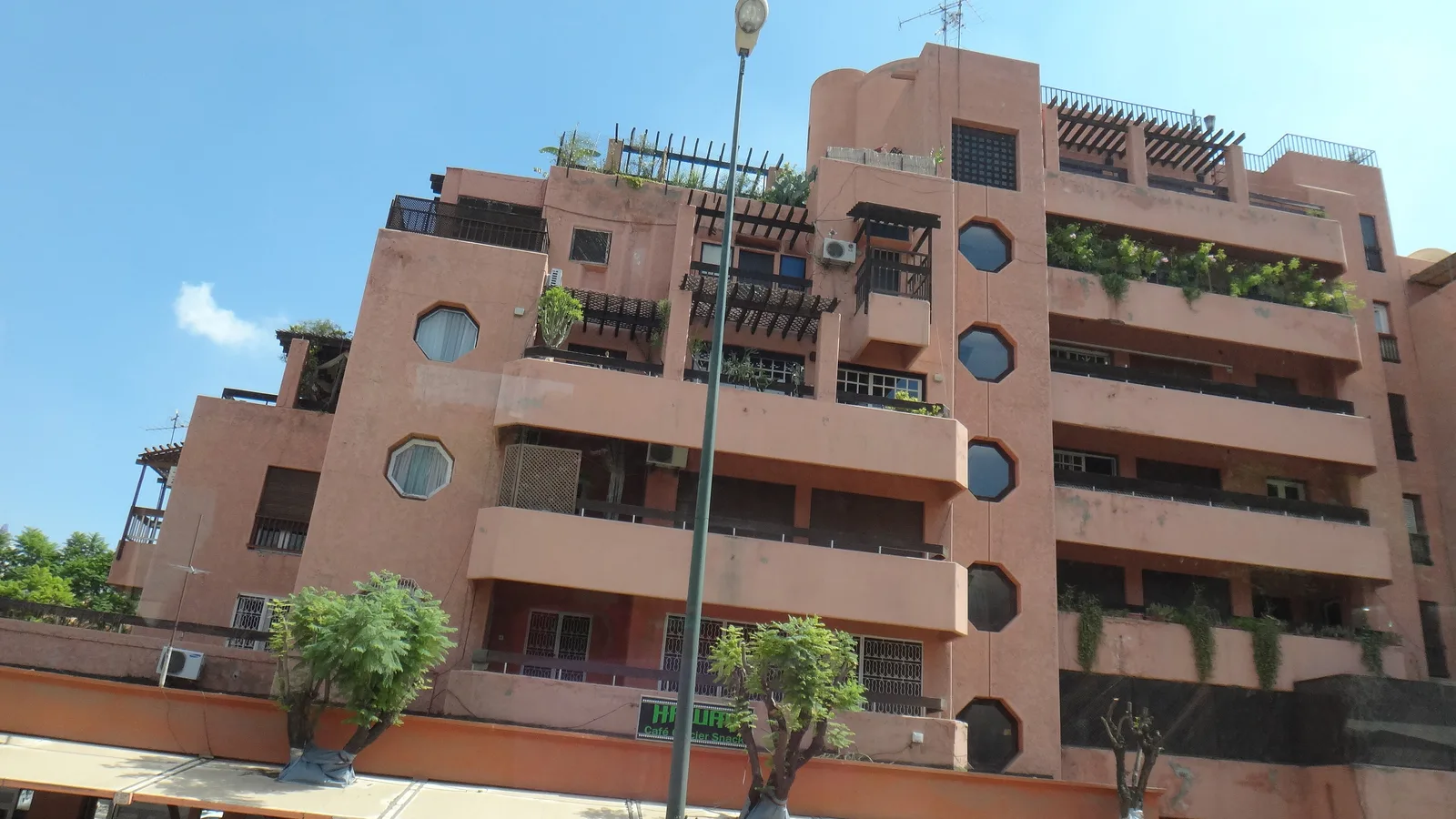
A foreign owner who buys an apartment in Guéliz or a villa in the Palmeraie almost always calculates their return on the gross rent. What they often forget: the syndic (co-ownership manager) fee, the management agency’s commission and, if they cannot sign in person, the cost of a power of attorney. Added together, these items can absorb 20 to 35% of the collected rent, before tax is even factored in. Here is what these costs actually cover, with the underlying legal texts and price ranges.
What a co-ownership fee really covers
The syndic contribution is not a flat tax: it funds specific line items, voted at the general assembly. The building guard’s salary usually accounts for 30 to 50% of a Moroccan building’s budget, followed by electricity for common areas, upkeep, and — where applicable — elevator maintenance and building insurance.
Ranges observed per unit in 2026:
- Small building (4 to 8 units, no elevator or guard): 100 to 200 MAD/month
- Mid-size building (15 to 25 units, elevator and guard): 200 to 400 MAD/month
- Upscale residence (30+ units, pool, security): 500 to 1,500 MAD/month
The legal calculation runs on “tantièmes,” the ownership share of each unit set out in the co-ownership bylaws: monthly fee = (annual approved budget ÷ 12) × (unit’s tantièmes ÷ total tantièmes). A unit representing 85 out of 1,000 tantièmes on an annual budget of 240,000 MAD would pay 1,700 MAD/month.
“Every building is different. A small building with no elevator doesn’t carry the same charges as a luxury residence in Marrakech with a pool and round-the-clock guard.”
The legal framework: Law 18-00, Law 106-12 and Decree 2.23.700
Co-ownership in Morocco is governed by Law 18-00, supplemented in 2016 by Law 106-12, then by Decree 2.23.700 published in Official Bulletin No. 7391 of March 31, 2025. For the first time, this text imposes standardized accounting: 12 annexes split into three categories based on the amount of charges called during the year — up to 200,000 MAD (small co-ownership, 3 annexes), between 200,000 and 500,000 MAD (medium, 3 annexes), above 500,000 MAD (large, 8 annexes).

Three points worth knowing before you buy:
- The budget is approved by a three-quarters majority of co-owners (Article 21) — a co-owner in the minority still has to pay even if they voted against it.
- The syndic must hold a bank account in the name of the co-ownership association (Article 26): no charge should move in cash without a receipt.
- Unpaid charges lapse after five years (Article 43), but remain due until that period has passed.
A syndic who fails to meet their accounting obligations can be removed by the general assembly with a three-quarters majority vote.
Managing remotely: power of attorney, mandate and real commissions
For an owner who does not live in Morocco, two separate issues arise: signing the paperwork, and running the property day to day.
To sign without traveling, Law 69-16 requires an authentic deed — drafted by a notary, two adouls, or a lawyer admitted to practice before the Court of Cassation. A power of attorney under private signature, even if legalized at the consulate, is void. Two routes exist: a consular power of attorney, signed before the Moroccan consul in the country of residence (2 to 3 weeks), or a power of attorney signed before a local notary, then apostilled or legalized for use in Morocco. The mandate should stay narrow — one identified property, a listed set of acts, a duration of 3 to 6 months — because an open-ended general power of attorney remains the most documented abuse scheme affecting Moroccans living abroad.
For day-to-day management, fees charged in Morocco tend to follow a fairly consistent scale:
| Type of management | Typical fee |
|---|---|
| Long-term rental management | ~10% (excl. tax) of the monthly rent |
| Placement for a long-term lease (12 months+) | 1 month’s rent (excl. tax), charged to both landlord and tenant |
| Short-term rental, essential package | from 18% of rental revenue |
| Short-term rental, full concierge package | up to 23% of rental revenue |
Concierge agencies managing tourist rentals in Marrakech must also ensure compliance with Law 80-14: an operating license, STDN registration and tax filings — a requirement many owners only discover during an inspection.
Net yield: the example that changes everything
Take an apartment in Guéliz rented for 6,000 MAD/month on a long-term lease, in a mid-size residence with a guard and elevator.
- Gross annual rent: 72,000 MAD
- Co-ownership fees (300 MAD/month): − 3,600 MAD
- Rental management fee (10% excl. tax): − 7,200 MAD
- Net income before tax: around 61,200 MAD, a nearly 15% deduction before rental income tax is even applied
On a property run as a short-term rental through a concierge agency charging a 20% commission, with higher co-ownership fees (a residence with a pool, 800 MAD/month), the combined deduction from fees and management frequently exceeds 25% of gross rental turnover — before cleaning, laundry and vacant periods.
Before you buy: what to check
- Ask for the minutes of the last general assembly and the itemized breakdown of charges
- Verify the unit’s tantièmes in the property title or the co-ownership bylaws
- Confirm the syndicate holds a bank account and check for significant arrears
- Compare commissions across several management agencies before signing a mandate, and verify their registration and local references
- Never sign an open-ended general power of attorney without a term or a floor price
These checks come on top of the ones already required when buying property in Morocco step by step and a careful read of the property taxes that apply in Marrakech.
What to remember
The yield advertised by an agency or a developer is almost always a gross yield. Between co-ownership fees — governed by Law 18-00 and its 2025 implementing decree — and the cost of remote management, a foreign owner should budget for a realistic 15 to 30% deduction before tax. That’s not a reason to avoid investing, but a parameter to plan for from day one rather than discover on the first fee statement.
For those considering short-term rental, these figures complement the detailed analysis of Marrakech’s short-term rental market, which covers regulation and seasonality.
Keywords
Disclaimer : This article is editorial analysis and does not constitute financial, legal or tax advice. Any investment decision should be preceded by consultation with qualified professionals.
Sources
- Kassaba — Syndic fees in Morocco: how charges are calculated (Law 18-00, art. 21, 26, 37, 43)
- Kassaba — New syndic law in Morocco: Decree 2.23.700, Official Bulletin No. 7391 of March 31, 2025
- SM Conciergerie Marrakech — Property management in Marrakech, packages and commissions
- ReaConsult — Power of attorney to sell or buy property in Morocco from abroad (guide for Moroccans living abroad)
- Val Foncier — Real estate agency fees in Morocco (property management rate card)